George Karous

Business Systems Specialist at Owen Mumford
Leamington Spa, United Kingdom

Five years delivering ERP, BI, integration and automation across medical device, pharmaceutical and life sciences manufacturing. I use system data to catch quality risks early, and I'm at home in validated, GxP-regulated environments.

Also on this page

Experience

  1. Feb 2026 – Present

    Owen Mumford

    Business Systems Specialist

    Regulated medical device manufacturer, Chipping Norton. I support the UK HQ and affiliates in Germany, France, the USA and Malaysia.

    • Own support and continuous improvement of the Epicor Kinetic ERP.
    • Spotted batch expiry date issues on a key product through Epicor data analysis, then built lot tracing and visualisation tools that gave the evidence to open a quality investigation.
    • Build with the Epicor Kinetic toolkit (BPMs, BAQs, Application Studio) across every function: batch allocation, recursive BOM roll-ups for part costing, automated stock fulfilment and SKU rationalisation.
    • Lead the rollout of Grow BI, combining Epicor, SharePoint and API data into reporting for six functions without Power BI access.
    • Write test plans and scripts for validated system changes, and run regression testing after upgrades and patches.
    • Manage Epicor contractors day to day, and work with integration partners to validate and fix EDI connections.
  2. Dec 2024 – Jan 2026

    idverde

    Business Systems Analyst, Support Services

    Grounds maintenance and landscaping, Coventry.

    • Built integrations with the OpenStreetMap and Google Maps APIs that fill in site addresses and generate QGIS boundary maps.
    • Automated ticketing workflows in Power Automate from SharePoint and calendar data, cutting manual effort and improving response times.
    • Delivered two contract go-lives end to end, including new integrations between customer SaaS platforms and internal tools.
    • Linked the business, the platform supplier and IT for the Service Delivery Platform, and set up a super-user forum that sped up issue resolution with subcontractors.
  3. Sep 2021 – Sep 2024

    AstraZeneca

    Technology Leadership Graduate Programme

    Five rotations through the value chain, in business and IT roles, in the UK and the USA.

    • Automated batch release assay testing with OCR, middleware and SAP BAPI integration, saving about £60,000 a year and removing manual transcription from GMP batch release.
    • Delivered a Power Platform solution for training requests, saving about £10,000 a year.
    • Project-managed an IoT proof of concept and scale-up connecting packing line machinery, integrating Zenon with MS Fabric.
    • Mapped the full cell therapy manufacturing process and prepared RFI documentation for apheresis track-and-trace.
    1. Oligonucleotides IT Uplift

      IT Project Manager

      Cambridge, Sep 2021 – May 2022

      Delivered a cell line assay tool and managed the migration from legacy products to strategic systems.

    2. Pharmaceutical Technology & Development

      Process Engineering / IT

      Macclesfield, May 2022 – Dec 2022

      Built a MATLAB pipeline for proprietary Agilent data and an app to assess tablet content uniformity.

    3. Ops IT, Biologics

      Business Analyst

      Maryland, USA, Apr 2023 – Nov 2023

      Led delivery of a GxP-compliant system tracking the IT compliance of lab assets, with Power BI reporting.

    4. Commercial IT, Patient

      Business Analyst

      Global, Nov 2023 – Apr 2024

      Wrote the business case that got cell therapy projects prioritised in the 2025 Commercial IT portfolio.

    5. Site Operations

      Data Analyst

      Macclesfield, Apr 2024 – Sep 2024

      Led the batch release automation, and drove adoption of Streamlit for self-service reporting.

Earlier

  • Finance Intern, Siemens Healthineers. Automation and simplification, reporting to the GB CFO.
  • Associate, data analysis and start-up, Flexio. Telehealth physiotherapy start-up.

Where I've lived and worked

  1. Brighton
  2. Durham
  3. Bern
  4. Durham
  5. Brighton
  6. Cambridge
  7. Macclesfield
  8. Maryland, USA
  9. Macclesfield
  10. Birmingham
  11. Leamington Spa

Imaging, simulation and 3D

I trained as a mechanical engineer, and my MSc was in image-based simulation. I still use the same chain today: take a scan or a design, turn it into a clean 3D model, then simulate it, print it or put it on the web.

Loading 3D model…

My knee, from MRI

Femur, tibia, patella and fibula, segmented from my own MRI.

From scans

Designed and printed

Drag to rotate. Scroll or pinch to zoom.

Personal project, 2026

MRI to 3D model: my own knee

A Python tool that reads a knee MRI, segments the bones with TotalSegmentator (a deep-learning model) and turns each bone into a smooth, closed surface I can view, print or publish.

  1. Read the DICOM series, keeping the scanner's orientation
  2. Segment the femur, tibia, patella and fibula
  3. Smooth across the 3 mm slices and resample to 0.5 mm
  4. Build closed surfaces with marching cubes and Taubin smoothing
  5. Export STL for printing and a small GLB for the web
The scan
T1 sagittal MRI: 27 slices 3 mm apart, with 0.42 mm pixels. Thick slices leave steps, so the meshing smooths and resamples across them.
The fix that mattered
The first version produced noise. It dropped the scan's orientation, so the model saw the knee sideways. Keeping the real geometry fixed it.

Tools: Python, TotalSegmentator, SimpleITK, scikit-image, trimesh, napari
MSc final project, Durham University

CT scan to blood-flow simulation

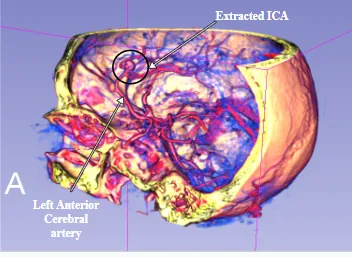
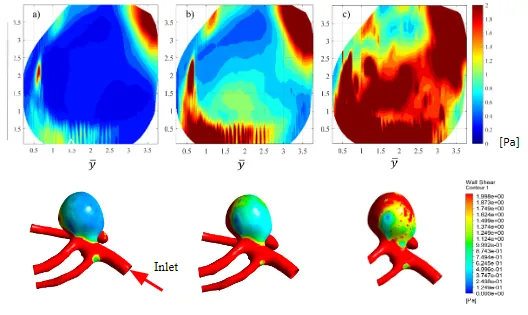
I created a method for segmenting CT scans and extracting patient-specific brain aneurysm geometry, then simulated how blood moves through the aneurysm and how its wall responds.

  1. Segment the vessels from the CT scan
  2. Clean the geometry and build simulation meshes
  3. Fluid model (CFD): blood as a shear-thinning fluid
  4. Solid model (CSD): the artery wall as a hyperelastic material
  5. Analyse flow vortices and wall shear stress
Why shear-thinning
Blood gets thinner as it flows faster. Inside an aneurysm the flow slows and recirculates, so a constant-viscosity model misjudges it.
Why hyperelastic
Artery walls stiffen as they stretch. A hyperelastic model captures that, where a simple linear one would not.
What it shows
Vortices inside the aneurysm sac, and wall shear stress across its surface, a measure widely studied in aneurysm growth and rupture research.

Tools: Ansys, Abaqus, OpenFOAM, MATLAB, ParaView

Ongoing

CAD, FEA and FDM printing

I design parts in SolidWorks, Onshape and Fusion 360, check them with FEA where loads matter, and print them on FDM printers. Topology optimisation lets the load paths decide where material goes.

Design and analysis
Parametric CAD, FEA, and topology optimisation to cut weight while keeping stiffness.
Printing
FDM, with parts designed for the process: orientation, supports and printable geometry.

Tools: SolidWorks, Onshape, Fusion 360, Ansys, FDM printing

Mycogrow

Mycogrow is my own venture: technology for growing and finding mushrooms. It started as a climate-controlled grow chamber and has grown into a weather-driven forecast and a phone app.

Grow chamber

An Arduino R4 WiFi controls temperature, humidity and fresh-air exchange for each species. An onboard web server shows live readings and set points, and logs to Firebase. I took it from concept through electrical and mechanical prototypes to funding applications.

Arduino, sensors, C++, Firebase

Build log on the Arduino forum

Flush forecast

I matched 26 years of UK field mushroom records against the weather before each find to learn what triggers a flush. A daily job now scores 3,900 points across the UK and publishes the results for the app.

Python, GBIF, Open-Meteo, GitHub Actions, Cloudflare R2

The app

An iPhone app, in development, that shows where and when to look, walks through a cautious find check, and keeps a private log of trips. It never sends your location, and never tells anyone a mushroom is safe to eat.

React Native, Expo, SQLite, TypeScript

Raspberry Pi server

A Raspberry Pi 5 at home runs my side projects, including a Strava dashboard in Django and the first version of this site, published safely through a Cloudflare Tunnel.

Linux, systemd, Cloudflare Tunnel

Loading map…

A flush forecast for field mushrooms

Field mushrooms appear after the right mix of rain and soil warmth. I tested that idea on 2,792 UK records from 2000 to 2026: each find day was compared with five control days at the same place, in the same year and on the same weekday.

Weather-only score from the daily run for 18 October 2026, 3,933 points. Rain and soil temperature from Open-Meteo.

Rain window
1–14 days before a find
Best soil temperature
About 13 °C (7-day mean)
Held-out score
0.69, where 0.5 is a coin toss
Data
2,162 find days against 10,810 control days

What the records show

Rain counts most 1–2 weeks before

Rain on each day before a find, compared with control days

Show the data
Days before findFind days (mm)Control days (mm)Difference
02.412.32+4%
12.912.49+17%
22.892.46+18%
33.072.44+26%
42.992.45+22%
53.082.41+28%
63.142.34+34%
73.052.33+31%
83.002.32+30%
93.092.41+28%
103.012.34+29%
112.852.34+22%
122.962.26+31%
133.032.35+29%
142.792.30+22%
152.632.41+9%
162.692.44+10%
172.652.40+11%
182.722.37+15%
192.692.46+9%
202.412.43-1%
212.492.39+4%
222.432.44-0%
232.442.49-2%
242.102.48-15%
252.122.43-13%
262.142.41-11%
271.962.46-20%
281.942.43-20%
291.942.49-22%
302.062.38-14%

Finds cluster at 12–16 °C soil

Share of days by 7-day soil temperature

  • Find days
  • Control days
Show the data
Soil temperatureFind daysControl days
4–5 °C0.1%1.2%
5–6 °C0.2%2.4%
6–7 °C1.0%3.0%
7–8 °C2.1%3.5%
8–9 °C4.3%4.2%
9–10 °C6.2%4.7%
10–11 °C7.2%4.9%
11–12 °C8.3%5.6%
12–13 °C11.5%5.9%
13–14 °C13.5%6.8%
14–15 °C13.2%7.5%
15–16 °C13.1%10.5%
16–17 °C11.3%11.6%
17–18 °C5.3%9.4%
18–19 °C2.1%7.0%
19–20 °C0.5%4.5%
20–21 °C0.1%2.6%

The season peaks in early October

Find days per week from 1 July, all years

Show the data
WeekFind days
From 1 Jul25
From 8 Jul28
From 15 Jul36
From 22 Jul64
From 29 Jul46
From 5 Aug71
From 12 Aug101
From 19 Aug120
From 26 Aug135
From 2 Sep122
From 9 Sep116
From 16 Sep127
From 23 Sep141
From 30 Sep157
From 7 Oct198
From 14 Oct174
From 21 Oct148
From 28 Oct125
From 4 Nov100
From 11 Nov80
From 18 Nov31
From 25 Nov17

Sightings: GBIF.org. Weather: Open-Meteo.com, ERA5 reanalysis (CC BY 4.0). UK outline: geoBoundaries (CC BY 4.0).

Mean-reversion scanner

A personal research project. Every weekday morning a Python system scans the FTSE 350 for shares pushed well below their recent average, then checks whether that set-up has actually paid in the past, after costs, before it suggests anything.

Illustration of a mean-reversion trade plan A made-up share price falls below its lower Bollinger band. The plan buys there, sets a stop 1.5 times the average true range below the entry, and targets the 20-day mean. Target: 20-day mean Stop: 1.5 × ATR Entry below lower band Bollinger Bands (2σ) around the 20-day mean Illustration with made-up prices
The set-up it looks for: a share stretched below its lower band, with a stop and target set before entry.

How it stays honest

  • There is no buy button. A signal is a prompt to look closer, never a trigger.
  • Every hit rate sits next to the do-nothing baseline.
  • Costs and out-of-sample checks come before any expected return.

Tools: Python, pandas, yfinance, Streamlit

Personal research. Not financial advice.

Every weekday morning

  1. Scan

    At 7am, pull prices for the FTSE 350 and compute moving averages, RSI, Bollinger Bands, MACD, ATR and volume.

  2. Test the edge

    For each signal that fires, compare its historical hit rate with simply holding. Small samples and zero-edge signals are flagged, not hidden.

  3. Check robustness

    Walk-forward testing: an edge only counts if it holds on data the model wasn't fitted to.

  4. Cost it

    Subtract stamp duty, spread and FX so the expected return is what you'd actually keep.

  5. Plan the trade

    Stop 1.5 × ATR below entry, target the 20-day mean, a fixed slice of the pot at risk, and a cap per holding.

  6. Manage the exit

    Take profit at the mean, exit on time after 10 trading days, and escalate anything in a downtrend.

  7. Guard concentration

    Flag a new idea that moves with something already held, since it would double the same bet.

  8. Grade itself

    Every suggestion is scored against the FTSE 100 after 10 trading days, so the system can be judged on its record.

Education

  • MSc Advanced Mechanical Engineering (with Aeromechanics)

    Durham University, Distinction, 2019–2020

  • BEng Mechanical & Electrical Engineering

    Durham University, 2:1, 2016–2019

  • APM Project Management Qualification (PMQ)

    Association for Project Management

  • Cross-functional Enabler (Lean)

  • Leading Self and Leading People

    AstraZeneca

  • Zenon data foundations

    COPA-DATA

Published writing

  • Digital Health

    Book chapter, Taylor & Francis (CRC Press). With Aditya Desai.

    Read the chapter

Skills

ERP and manufacturing systems
Epicor Kinetic (BPMs, BAQs, Application Studio), SAP MM/WM concepts, EDI, Maximo, BarTender, OSI-PI, Zenon, PAS-X
Quality and compliance
Lot traceability, Batch and expiry data analysis, Quality investigation support, Data integrity, GxP, Validated systems testing, IT change management
Data and reporting
Grow BI, Power BI, Tableau, MS Fabric, SQL, Streamlit
Integration and automation
REST APIs and JSON, Python, PowerShell, Power Automate, UiPath, Automation Anywhere, OCR, Dataiku
Business analysis and delivery
Requirements, AS-IS / TO-BE mapping, Gap analysis, User stories, Business cases, Plan to Make, Order to Cash, Agile, Scrum and Waterfall, Risk and budget, Supplier management
Engineering and infrastructure
CFD and CSD, Ansys, Abaqus, OpenFOAM, MATLAB, SolidWorks, Onshape, AWS and Azure, Linux, Arduino, Raspberry Pi

Outside work

I like learning by building: trading bots, sensors, printed parts, whatever the current question is. Beyond tech I'm into sport, nutrition, aviation, medicine, sustainability, philosophy and reading.

Get in touch

Happy to talk about business systems, ERP, data and automation. Send a message here or on LinkedIn.

Message me on LinkedIn